


The Quiet Champions of Park and Sweetgrass Counties
Inside the CASA program changing children’s lives — one steady voice at a time

There are causes we admire from a distance, and then there are the ones woven so tightly into the fabric of our lives that they feel almost like family. CASA — Court Appointed Special Advocates — is one of those for us. So when Built in The WEST Podcast sat down with two remarkable women shepherding this work in Park and Sweetgrass Counties, we knew the conversation belonged in these pages.
Host Kelly Bonnell — a CASA volunteer and board member of more than fifteen years, from Northwest Montana to Las Vegas and back home to Livingston — welcomed Anne Schilling, the founder who brought CASA to our two counties, and Carolyn Dettori, the new incoming Director carrying that legacy forward.
How It All Began
More than two decades ago, Judge Nels Swandal asked the community a simple question: would Park County stand up for its most vulnerable children? Forty or fifty people came to that first meeting at the courthouse. By the third gathering, the room had thinned to roughly a dozen — and those few became the founding board.
The paperwork for 501(c)(3) status, bylaws, and state registration took nearly a year. CASA of Park and Sweetgrass Counties received its nonprofit status in 2001 and accepted its first cases in 2002. Anne’s very first training class produced twelve volunteers — a number that has multiplied many times over in the years since.
The Eyes and Ears of the Judge
When a child is removed from a home due to abuse or neglect, a CASA is appointed by the judge to represent that child’s best interests — not what the parents want, not even necessarily what the child wants, but what is genuinely best for the child. As Anne explains it, the CASA serves as the eyes and ears of the judge, an independent voice gathering information that might never otherwise reach the bench.
And here is the statistic that anchors everything: roughly 98% of the time, the CASA is the one constant in that child’s life. Caseworkers change. Attorneys rotate. Foster placements shift. But the CASA — that one familiar face — remains.
“Research shows that even one healthy, stable adult relationship can help a child overcome enormous adversity and build resiliency.”
Trained, Trusted, Empowered
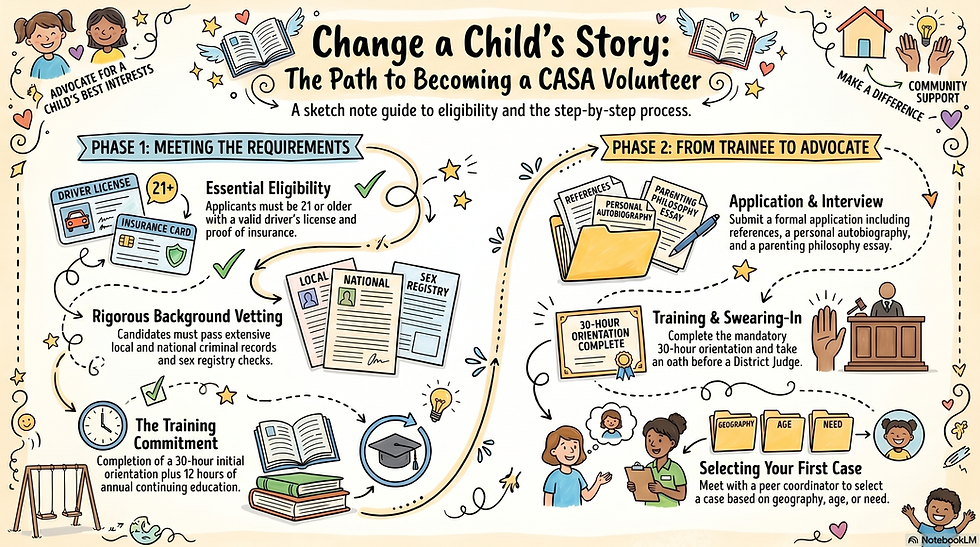
Becoming a CASA is a national commitment. Volunteers complete 30 hours of initial training — most of it in person again now — covering child development, the realities of substance abuse and mental health, the foundations of poverty, the workings of the court system, and the practical skill of writing a court report. Volunteers also complete 12 hours of continuing education each year, including training under the Indian Child Welfare Act (ICWA) and the deeply meaningful work around Adverse Childhood Experiences (ACEs).
You don’t need a background in social work or child welfare to step into this role. You need a willing heart and the courage to learn.
Stories That Stay With You
Anne shared the story of a young man — we’ll call him Billy — who came into CASA in deeply difficult circumstances. With a steady CASA in his corner, he graduated from Bozeman High School, completed a college program for young adults with disabilities, and now lives in a shared apartment, working and thriving. This summer, he’ll travel to Minnesota to represent Montana at the national Special Olympics.
Carolyn shared something equally moving. Since stepping into the director role this January, friends and family who came up through the foster system have begun opening up to her, recounting their own CASAs decades later — lighting up at the memory of someone who simply showed up and stayed. “As if it was just a couple of weeks ago,” she said.
How Our Community Can Help
There are meaningful ways to come alongside this work:
Become a volunteer. Training cohorts run twice yearly — typically in the spring and again in late September through October.
Give through Give A Hoot (Park County, July) and Sweetgrass Give Where You Live (Big Timber, summer). Both campaigns match donations — your gift literally doubles.
Support foster families. Carolyn names this as one of the most pressing community needs — from welcoming new foster families to providing respite care so existing families can rest and continue.
Spread the word. Awareness is the doorway to volunteers, donors, and foster homes. Share this story.
A Legacy and a Beginning
Asked what CASA has given her after twenty-five years, Anne grew quiet. “It has made me a better person,” she said. The work, she explained, has expanded her acceptance of people from every walk of life and humbled her again and again as she watched volunteers, parents, and caseworkers pour themselves out for children.
Carolyn steps in with the same heart and a fresh vision: more visibility, more foster family support, and the steady continuation of work that has changed the trajectory of so many young lives. She calls it a privilege — and after listening to her speak, you understand why.
LISTEN · CONNECT · GIVE
Hear the full conversation on Built in The WEST Podcast with host Kelly Bonnell.
We invite you — our Rustic Elegance readers — to listen to conversation with Anne and Carolyn. Their voices carry something a transcript cannot: tenderness, conviction, and the quiet weight of work done well over many years.
Learn more or get involved: casajd6.org
CASA of Park and Sweetgrass Counties · Court Appointed Special Advocates

❖


Comments