


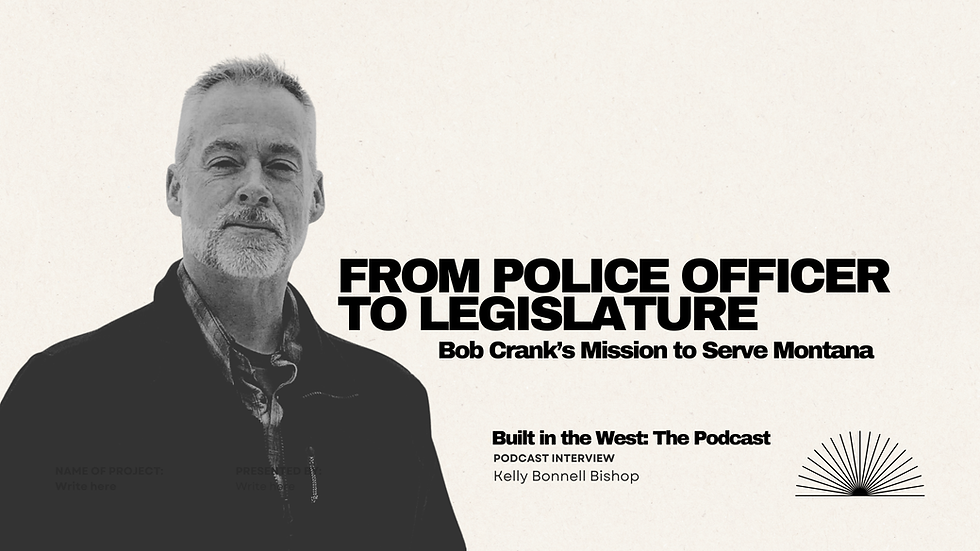
From Volleyball Courts to Patrol Cars Bob Crank's Journey to House District 57
Updated: May 6
A Built in the West Podcast Conversation

Some people find Montana. Others are claimed by it. Bob Crank's story is the latter—a tale of Instagram posts, horseback rides through Paradise Valley, and a dog who picked her owner at a bar in Clyde Park. Now, after nearly 20 years coaching college volleyball and adventures spanning from New Zealand to Hawaii, this Livingston police officer is ready for his next act of service: representing House District 57 in the Montana Legislature.
The Unconventional Path to Montana
Bob Crank doesn't fit the typical Montana politician mold, and he'd be the first to tell you that. Originally from the Midwest, his path to Livingston reads like an adventure novel. After spending nearly two decades as a college volleyball coach, he quit to embark on what he calls "a big grand adventure."
"I spent a couple months hiking through New Zealand, had a layover in Hawaii, and ended up living there for a couple years," he recalls. But it was an Instagram post that changed everything: "Get paid to go horseback riding and hiking in Montana."
A few weeks later, he was working as an outdoor adventure guide for Austin Adventures out of Billings, leading the Yellowstone Trip series through Paradise Valley. "We took our guests horseback riding on a local family cow-calf beef cattle operation that offered dude rides, and I became really close with the family—the Davis family."
That connection deepened over multiple seasons of guiding. "I found myself down at the family ranch every fall and spring for a number of years. As I grew closer to the family, I decided to make it permanent."
His permanent move to Livingston came through another form of service: the Livingston Police Department hired him nearly three years ago, and he's been serving the community in uniform ever since.
"I didn't come here to change Montana. I fell in love with Montana being here. If the Davis family accepted me, I must be of the right character to be here."
A Servant's Heart
"Community service is kind of a big thing for me," Bob explains when asked what drew him to run for office. "I'm always interested in finding new ways to be in service to people I care about. Moving here permanently, I thought, what better way to be a new community member than to be in service to this community that's adopted and accepted me?"
His life now oscillates between two worlds: patrol car and mountain trails. "I'm either in a patrol car or I am in the mountains. That's the way my life is." As an elk hunting guide for the Davis family on top of his police work, he spends his off-days deep in the backcountry.
This dual existence gives him unique insight into the issues facing House District 57, which covers a sprawling, oddly-shaped territory. "Redistricting happened a couple years ago and it's changed a lot of the map," he notes. The district includes a piece of downtown Bozeman, parts of Gallatin County, then skips Livingston to encompass Wilsall, Clyde Park, Pray, Emigrant, and extends all the way to Gardiner and Cooke City.
"It is very weird to see such rural, ingrained communities in addition to more township-style communities. Trying to meld those two things together is tough. So yeah, we gotta do a lot of driving. The old F-150 is making its rounds for sure."
Property Taxes: A Radical Rethink
Ask Bob about property taxes and you get more than talking points—you get a completely reimagined system. "Property taxes are obviously a hot topic in Montana right now," he begins, describing a recent meet-and-greet where one person thanked him because their taxes went down while, five minutes later, another was furious that theirs had doubled.
"It's a very convoluted process. Talking with some of the incumbents who were there during that session, it seems almost every person in that legislature was upset about some component of that bill. So is it a clean bill? Certainly not. Is it transparent? Not really."
His solution is radical in its simplicity: charge per property or per acre based on property type, not market value. "Right now there are three entities that decide what you pay. One is the government—we decide the percentage rate. But an appraiser comes out and evaluates your home. There's a human component to that. Then the housing market itself dictates your ultimate property tax."
He paints a vivid picture: "I could walk down East Lewis Street here in Livingston. I could find one house valued at $700,000, and literally across the street, one valued at $400,000. They have the same access to water, the same sewage, the same trash pickup, the same police and fire and EMS response. All the same infrastructure and services. The difference in their property tax is based on the housing market."
"You have literally no control whatsoever in what you ultimately pay in property tax. Could we change the system to say, it's the same area, they have all the same basic services—they're both single-family residential homes. Why is one paying so much more than the other? They get the same stuff."
His proposed system would categorize by property type: commercial, agricultural, single-family residential, even distinguishing between rental properties and owner-occupied homes. "I think we can clean it up to make it easier to understand and more fair. It's just a matter of whether we can get any movement from Republican counterparts to help sponsor and co-sponsor and get it to committee."
The current system, he argues, taxes people on unrealized gains. "You bought this house 15, 20 years ago for $250,000, and now all of a sudden it's worth $600,000. You're getting taxed for a $600,000 evaluation of your property. That is not what you purchased in any way, shape, or form."
He references emerging research from an entity out of Chicago examining appraisal discrepancies. "We're finding that higher-evaluated homes are being under-evaluated, whereas lower-value homes are being over-evaluated. Someone who has less money and a lower-valued home—their property was evaluated a little bit higher than it should have been. They're still writing a check for a lesser amount, but there's still margins there."
Forest Management: Loving It to Death
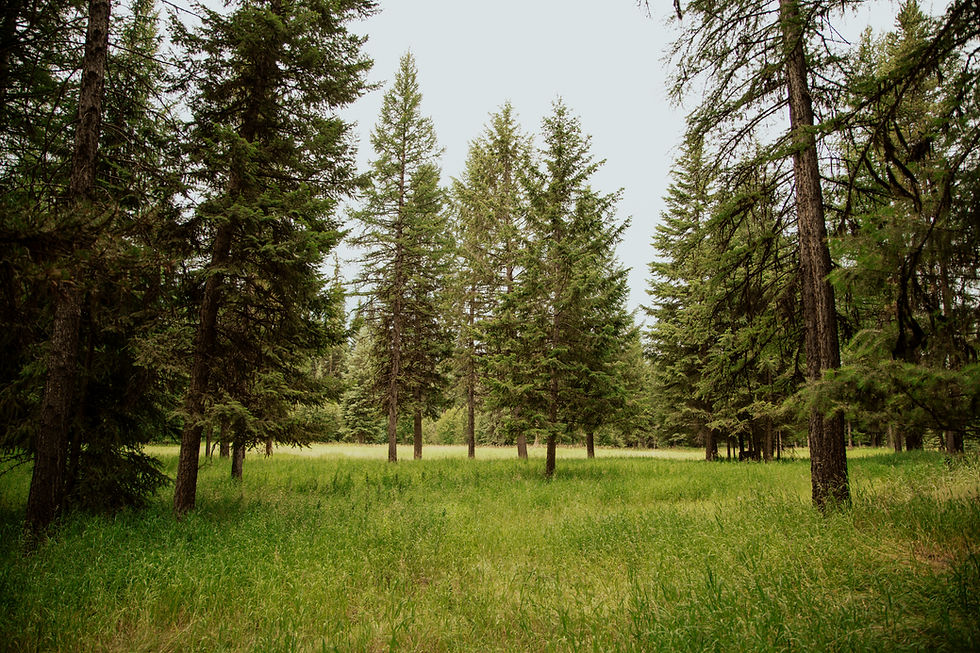
Bob credits his friend Jason Gunderson, a fellow police officer running for the state Senate, with one of his favorite phrases about Montana forests: "We have to stop loving our forest to death."
As someone who spends every available day off in the mountains—either hiking, elk hunting, or guiding—Bob has witnessed the deterioration firsthand. "When you get up in there, you really find out how unhealthy a lot of these forests are. The amount of deadfall up there is crazy. And I don't think a lot of people understand."
He brings the expertise of his guiding background to the conversation. "I spent quite a few years as an outdoor adventure guide. I learned a lot about the Yellowstone region. We learned a lot from the '88 fires in Yellowstone. Wildland firefighters learned an immense amount, and we learned about fire ecology."
The terminology shift matters to him: "This is why we changed it from a 'controlled burn' to a 'prescribed burn.' Those are two different things. We now know spending generations stopping wildfire—and I don't want to take away from how devastating they can be, I want to protect people's property and homes—but when we have massive swaths of land that are a powder keg, that entire drainage is at risk."
He points to Pine Creek as an immediate example. "You go up Pine Creek right now, and if a fire even sparks, that entire drainage is devastated."
His time guiding in Yosemite National Park showed him an alt
ernative approach. "They still mechanically thin and prescribe burn a lot of that valley, and they've been doing that since before white people ever lived here. The indigenous native cultures were prescribed burning that area since the dawn of time."
"If we can get those logs out of there, get that fuel out, one: our state can make more money on the profit of the wood. But two: if and when wildfires do start, they're not as destructive."
The science supports his position. "We're an arid climate with large areas of pine and fir trees. Lodgepole pine has a specific pine cone designed to open up in massive heat to release seeds. This type of environment was designed to have low, fast-moving fires burn through and take the underbrush out. That's the way it has always been.

"Now we've created this environment where it creates slow-moving, incredibly hot fires, and that devastates literally all of it. Nothing survives. No management is mismanagement. We can't just let it sit there vacant."
The Ted Lasso Philosophy of Public Service
When asked how he bridges the gap between being an outsider and earning the trust of longtime Montanans, Bob returns to his coaching roots. "Twenty years as a college volleyball coach—the whole idea of that is making kids better. I've always been more of the help-your-neighbor kind of person."
He references the popular TV show with a knowing smile. "I kind of had the Ted Lasso philosophy to some extent before the show even came out. I really believed my goal and my purpose as a coach was to improve the human beings and the individuals that played for me."
"Winning is winning, but as a coach, I have never won or lost a volleyball game in my entire coaching career. My job was: what are we doing Monday, Tuesday, Wednesday, Thursday? How can I improve these individuals as a team through the week? Then they go out and showcase themselves during games. I don't win volleyball matches. Never have. Those kids win. I have to focus on what I'm doing every day in the practice gym."
He carries that same philosophy into his vision for legislative service. "I didn't come here to change Montana. I fell in love with Montana being here. I feel like if the Davis family accepted me, I must be of the right character to be here. I take that as a vote of confidence."
An old football coaching philosophy resonates with him: "They had this philosophy about rowing the boat—it's the coach's job to steer, but we all have to row. Ironically, this takes me back to Hawaii. I actually got selected to be on an outrigger canoe team." He laughs. "They don't row. They paddle. But we all have to do that. If we're not all in sync and we're not all moving, that canoe or boat's not going anywhere."
"I'd just rather be part of the force moving in a positive direction. I didn't come here to change any values. I want people to remain neighborly. I want people to work hard, be successful. I don't want people to worry about what government is doing. Government shouldn't impact your lives every day."
The Dog Who Chose Her Person
Bob's life outside of work is remarkably simple. "I live a pretty basic life. I'm either here in town in my patrol car or I am at the ranch in the mountains with the dog. I don't do much else."

That dog has her own story—one that encapsulates the Montana experience Bob has grown to love. "My best guess is she's a blue heeler-German shorthair mix. I got her for free at Antlers in Clyde Park."
The tale unfolds like a perfect Montana moment: "I was working cows up in the Bangtails, and me and a buddy decided we'd stop at Antlers on the way home and have a beer. This dog just walked up and laid on my feet, and the old rancher that originally owned her just walked up and said, 'Well, she seems to like you, so I guess she's yours.'"
"So I left Antlers Bar with a dog. She has been following me everywhere. I've always kind of joked with people who use the term 'I rescued this dog.' You went to a facility, you picked it up, you feed it. I am now a true believer that dogs claim their people. I didn't really know that was true until this happened, but she follows me everywhere. I've never seen anything like it."
The rancher was willing to part with her for a simple reason: "She wasn't mean enough to the cows." For Bob, that was perfect. "She has definitely enriched my life, and I'm glad to have an amazing hiking partner out there."
Statesman, Not Politician
Bob makes a clear distinction about his approach to elected office, citing wisdom from a former Army captain who reached out when Bob announced his candidacy. "I was making a video about the difference between being a politician and a statesman. I don't really care for politics. I don't care for career politicians. That's one of the reasons I love Montana's system—we're not career politicians. We're part-time citizen legislators."
His former captain, who retired as a lieutenant colonel after their deployment to Iraq together, shared a quote from an old philosopher: "Politicians only think of their next election. Statesmen think of the next generation."
"I look at my role as a statesman," Bob says firmly. "I don't care about the election in a large sense. Sure, I want to get elected, but my focus is: how can I best serve?"
That service mindset extends to his vision for how his law enforcement experience should factor into his legislative work. "I would hope that we would put people with certain strengths, experience, and knowledge in places where those could do the most good. I hope that if I can be in an environment where my experience and knowledge as a law enforcement officer can be useful to ensure bills are written appropriately, then I hope we can do that."
He points to previous sessions where property rights issues were handled by committee members with litigation experience. "That makes sense. They have the most knowledge and education. Why wouldn't you put them there?"
Protecting Montana's Identity
When asked what he most wants to protect about Montana, Bob doesn't hesitate: the culture of being neighborly. "I think one of the best parts about being in Montana is how many people still have the sense of being neighborly. That is almost a culture in and of itself."
He draws on his ranch work for examples. "Working in the valley, Steve across the highway comes over and helps with our cows and we go over and help with his cows. Obviously you can't go across Calendar Street here and help with cows, but I still think that's such an important piece of human nature that I don't want to lose sight of. Montana has had such a strong hold on that particular characteristic for such a long time. And I think it's slipping."
From his law enforcement perspective, he sees other troubling trends. "Public safety and public community is such an important thing. We're seeing increased numbers of poor or careless driving, crime rates of different styles and types. The amount of drugs running around right now is absolutely preposterous, and that's causing a massive problem."
He returns to the community theme with a pointed observation about cultural shifts. "I remember back in the days where my friend's dad was allowed to beat me if I acted out of line." He laughs. "Now it's 'I'm suing somebody.' I think we need to get back to the idea that it takes a village to raise a child. If we have a better community, we're gonna have better children. If we have better children, we have a better future."
"Parts of rural Montana still have that community identity, and some of the smaller towns still have it, but as towns get bigger, we lose more and more of the identity of Montana. I would rather not do that. I want to keep the identity of Montana alive."
Following the Money
One issue keeps coming up in Bob's conversations with constituents and fellow candidates: where marijuana tax revenue actually goes. "It was designed to go to some specific places, but it doesn't seem to be showing up where it was supposed to," he notes.
The same question applies to lottery funds. "When they implemented the Montana lottery, the money was supposed to be allotted for certain things like schools and roads. Again, I don't think that's where some of that money ended up."
His solution is straightforward: "It would be great to get a deep dive and more transparency in our government's budget because I think there is a lot of wasted money going on."
This ties into his broader philosophy of government. "I don't think people should worry about government, and the more we can be transparent and the less of your money we can spend, the better we all are going to end up being."
An Accessible Servant

Bob wants constituents to know above all else that he's trying "the best I can to be accessible to them. I'm interested in getting their opinions and insights. My only focus is being their servant."
He's honest about his weaknesses. "I am a horrible fundraiser. I hate fundraising. I have no problem explaining why I need it, but I hate doing it. That's the part about politics I hate the most. But as far as engaging with people and sharing ideas and talking through ideas? This is the part of the job that I like."
His approach to campaigning reflects his values. "I have a website, Facebook, Instagram, an email address. I am more than willing to accept ideas, input, insights. I want to make sure that if and when I get elected, I am prepared to address the issues that are most important to the most people in our community."
That old F-150 will keep making its rounds through the sprawling district—from downtown Bozeman to Cooke City, from Wilsall to Gardiner. "The more people I can connect with electronically, through things like this wonderful podcast, the more people I can reach, and the more people will understand what we're trying to do."
*
As the interview winds down, Bob's story comes full circle—from Midwest volleyball courts to New Zealand trails, from Hawaiian outrigger canoes to Paradise Valley cattle drives, from that fateful Instagram post to a patrol car in Livingston. He didn't come to Montana to be a politician. He came because a place and its people claimed him, and now he's ready to serve them in a new way.
The question for voters in House District 57 is whether they're ready to send a statesman—one more comfortable in hiking boots than in political machinery—to Helena to row the boat in the right direction.
Contact Bob Crank through his website, Facebook, and Instagram to share your ideas and insights.


Comments